Betting on robots the
world can rely on.
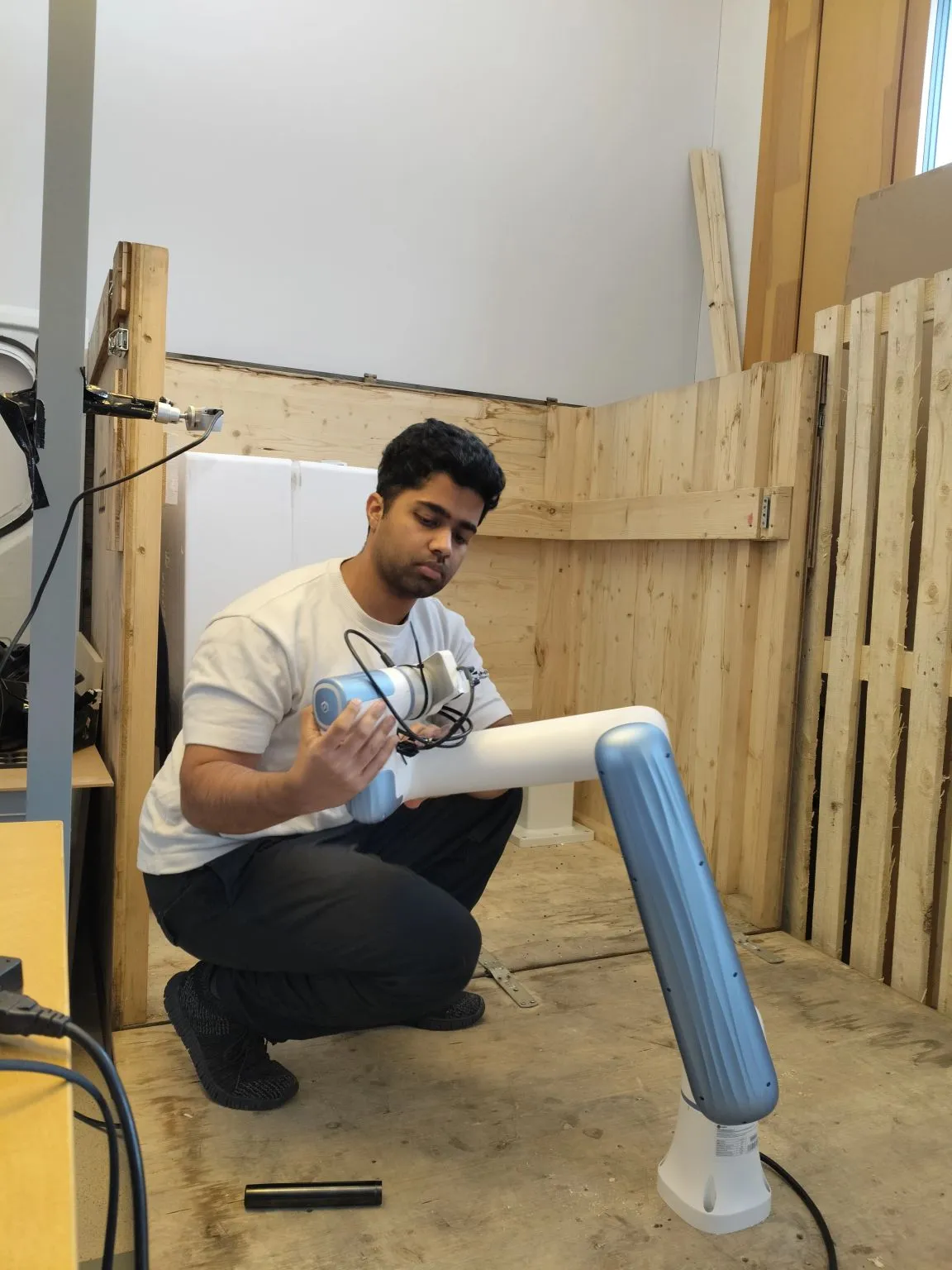
I'm a robotics and AI engineer with an MSc in Robotics from TU Delft and a mechanical-engineering foundation from NITK Surathkal.
Professionally, my work has been about reliability. At Qafka Robotics I helped deliver robot autonomy that had to work over 99% of the time, repeatably, across changing weather, lighting, and edge cases, with the failure handling to back it up. Next I'm joining Lely as a Rapid Prototyping Engineer.
My independent bet is more focused: embodied foundation models need the reliability and fine-grained control that made classical robotics useful in industry. VLAs and world models are powerful, but they have to become interpretable and steerable before anyone can trust them outside a clean lab. Robotics doesn't get to be 83% right; on a real machine, small errors compound into failures.
None of this was a master plan. Looking back, the same instinct keeps surfacing: a master's thesis at TU Delft on multi-LLM interfaces for supermarket robots, real-world deployment at Qafka, the Alpine Valley exploration into VLA interpretability, open-source robotics tooling, and writing it up in public. This site isn't a highlight reel. It's the proof that I'm building toward the bet, not just talking about it.
- Interpretable & Steerable Embodied AI
- Robot Learning & VLAs
- Real-world Robotics Reliability
- Human-Robot Interaction
- Real-world robotics integration
- Rapid prototyping
- Perception-action systems
- Policy supervision loops
- Technical writing
- Product and interface thinking